
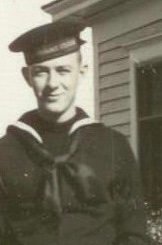
- Rank:
- Branch:
- Home Town:
- Date Of Birth:
- Disposition:
- Family DNA on File:
F2c Buford Earl Bonebrake
When Buford Earl Bonebrake returned to Concordia, Kansas on leave from the Navy in the summer of 1941, “he had grown up a little bit,” the local newspaper said.
But “there was still the profound, boyish seriousness that lurked behind a slow smile and the twinkle of blue eyes. He was less gangling. He walked with the dignity that his height deserved. The outrageously tousled hair had been cropped.”
He was a fireman second class on the U.S.S. Arizona when he was killed in the Japanese attack on Pearl Harbor, Dec. 7, 1941. He’d enlisted on Oct. 11, 1940 — three days after he turned 18.
The Concordia Blade-Empire’s obituary described “Boop” Bonebrake as “one of ours.”
Mr. Bonebrake was born in Concordia, a town of about 6,000, to Charles Bonebrake, a truck driver who served in the Army in France in World War I, and Mabel Driscoll Bonebrake, then a homemaker.
When the son applied to the Navy in September 1940 he said he’d completed 11th grade and that he worked as a clerk at Roger’s Fruit Store. He also had a newspaper route. His parents were divorced by then. He was in the school band also played baseball and on the Sanitary Milk softball team.
As for most Americans during the Great Depression, times were difficult for the family. The 1940 Census said his mother was head of the household, which included four sons and two lodgers. She worked for the National Youth Administration, a federal jobs and training program. Buford had his paper route and an older brother, Otis, worked in construction. Their combined 1939 income was $1,003.
In his last letter home Mr. Bonebrake told his mother that he planned to go to Honolulu the next day — Thanksgiving — to watch a football game and then perhaps attend a dance. He mentioned sending money home and advised that if she didn’t have to spend it, she should buy a wedding present for Otis.
Otis, too, died in the war. He was an Army first lieutenant in France in January 1945 when the company he commanded was surrounded by Germans. The family believed he was taken prisoner, but after his fellow soldiers were freed they said he was shot in the head during the battle and died at a German medical station.
A third brother, Charles, also served in the Navy during World War II and survived. The youngest, Rex, was in the Navy during the Korean war.