
Pearl Harbor Families and Their Sacrifice
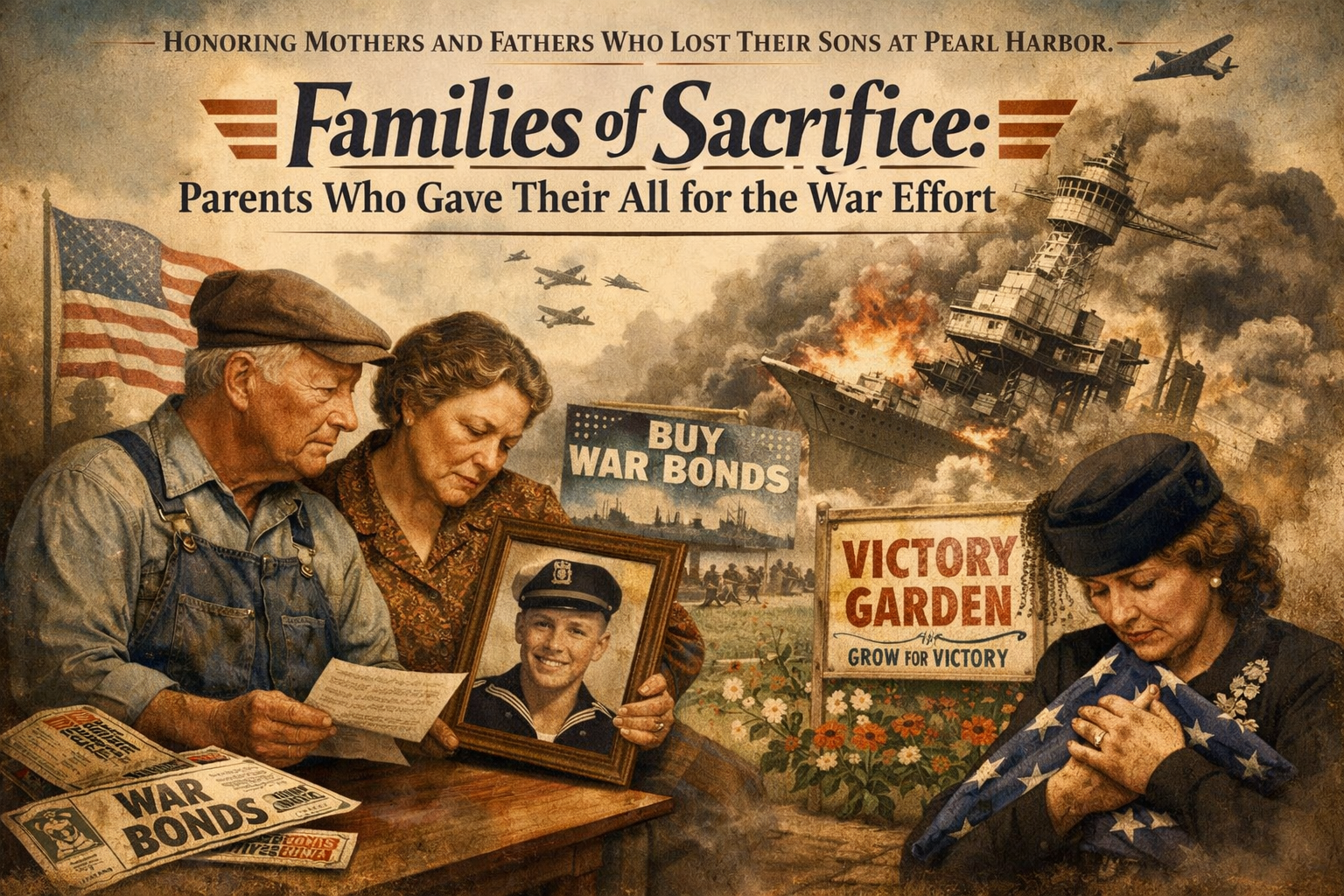
Pearl Harbor Families and Their Sacrifice
Written by: Bobbi Jo Buhl
In the wake of Pearl Harbor, some U.S.S. Arizona families turned grief into sacrifice—rejecting death payments, buying war bonds, and giving even more to the nation their sons died defending.
Two months to the day after sailor Charles Titus Anderson was killed in the Japanese attack on Pearl Harbor, his parents wrote to the Navy.
“Am returning to you (the) form for six months’ gratuity pay,” their letter said. “We started to fill out this form but it seems too much like selling our boy. We gave our son to uncle Sam. We know in our hearts our boy was glad to give his all for his country.”
Charles Titus was the son of Charles S. Anderson, a steel worker, and Etta Trent Anderson, a homemaker. Young Charles was born in Indiana, but by the time he enlisted, the family lived in Elsinore, California.
The Andersons were entitled to six months of their son’s pay. He was a carpenter’s mate second class on the U.S.S. Arizona, which made the $564 total payment no small sum. The average American family back then earned about $2,000 a year.
His parents also wrote that if thousands of families received the death payment “what would be left to fight the yellow snakes with.” They concluded with this: “We are proud he died defending the greatest and best country in the world. We want to do our bit to keep it so.”
Parents of other men killed on the Arizona men appeared at public events across the country to encourage the purchase of war bonds. Money from bond sales helped pay for the construction of ships, planes and other equipment. In return, the government paid guaranteed interest to buyers who held the bonds until they matured in 10 years.
Charles and Emma Kieselbach, lost their son, Charles Jr., on the Arizona and had two other sons in the war. Emma planted a “victory” garden, patched old clothes and volunteered at the Red Cross. But their purchase of bonds was most important, she said.
“If we want to be able to face our boys when they come back, we’ll have to be all-out for victory now,” she told a reporter for their local Jefferson City, Missouri, newspaper. “They’re offering their lives.”
Catawba County, North Carolina, farmers Amos and Lillie Hilton sent seven sons off to war and two of them died — Wilson Woodrow Hilton on the Arizona and Berlin Hilton in the Coast Guard in New Guinea. After the war started the parents sold their farm for about $1,000 profit and bought a smaller one nearby. They had plans for the money, but ultimately decided to plow it into war bonds.
The mother of Clevelander Bernard Fields supported the war-time government in another way. She insisted on paying the $39 in income tax she calculated he owed on his earnings as a radioman on the Arizona. He didn’t actually owe anything because he left no estate. But his mother, Sylvia Feigenbaum, said her son would have wanted to pay.
An editorial in the Louisville Courier-Journal said that when Bernard died “he took with him an integrity held also by his mother, with which she honored him in death.”