
How USS Arizona Families in Long Beach Endured After Pearl Harbor
How USS Arizona Families in Long Beach Endured After Pearl Harbor
After the attack on Pearl Harbor, Long Beach, California became a city of mourning, resilience, and quiet service for U.S.S. Arizona families.
Written by: Bobbie Jo Buel
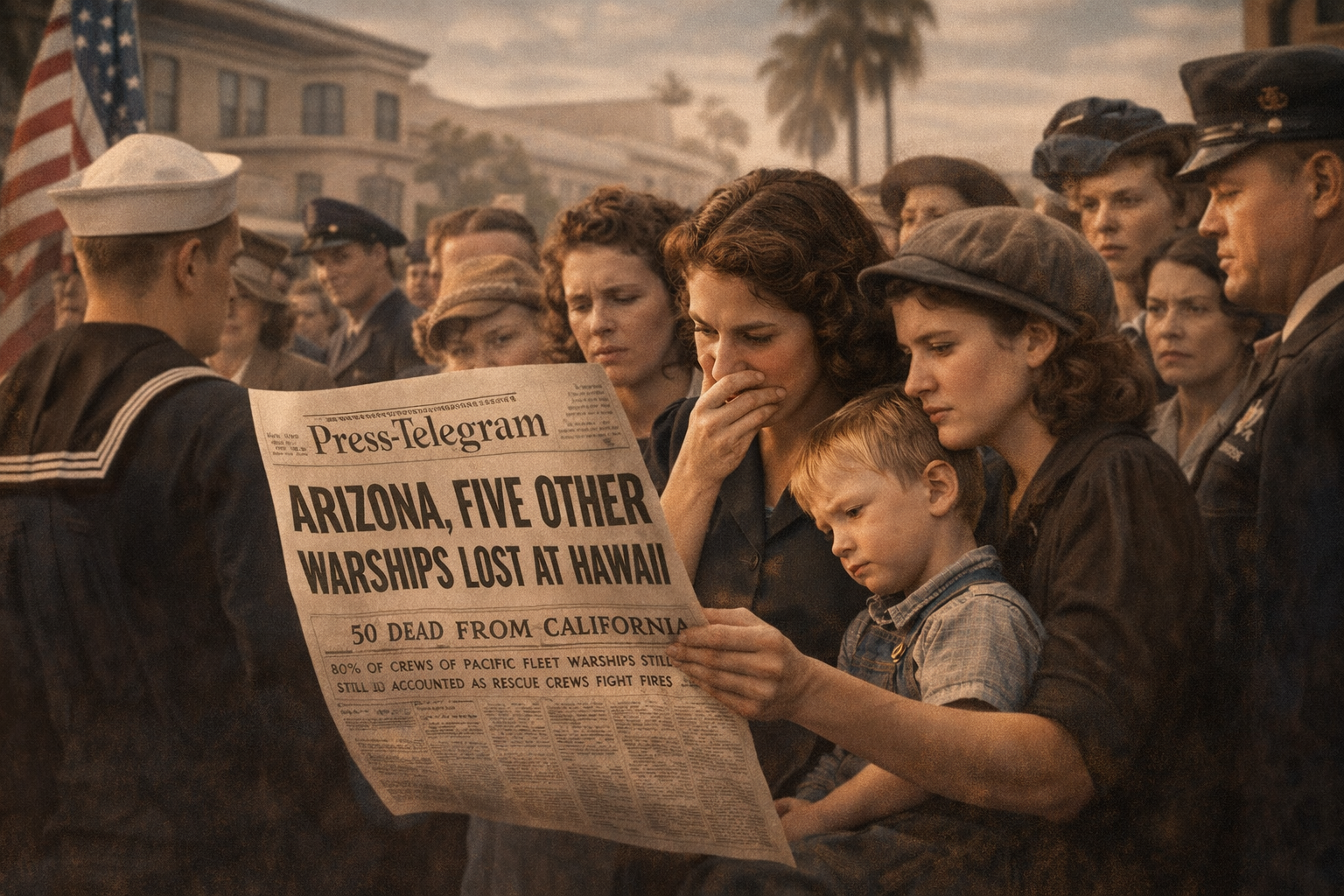
On Dec. 15, 1941 a headline across the front of the Long Beach, California, Press-Telegram announced: “ARIZONA, FIVE OTHER WARSHIPS LOST AT HAWAII.”
It was terrible news in a city that was the adopted home of hundreds of Navy and Marine families.
About 75 of the men killed on the Arizona in the Japanese attack on Pearl Harbor had wives, children or parents at Long Beach. Another 40 or so families had men who were killed on the Oklahoma, West Virginia, Utah, Nevada or California.
Most of the Navy men chose Long Beach, a city of 164,000, because it was the best opportunity for sailors to spend time with loved ones. Long Beach is just across the bay from San Pedro, where the battleships often stopped when they visited the mainland United States. San Pedro had even been the official home of the Pacific fleet before it moved to Hawaii in December 1940.
On Dec. 17 local leaders announced a citywide memorial service, pending approval from Washington. About Dec. 20 families began to receive telegrams that specific men were “missing in action.”
Meanwhile, communities all along the West Coast were taking precautions against further attack. They implemented nightly bans on non-military aircraft and imposed blackouts. In the early days, all windows, skylights and other openings visible from the sky had to be covered from before sundown until after sunup. If enemy planes were spotted, Long Beach’s fire stations would sound warning sirens.
The Press-Telegram said Navy wives knew when they married that their life “might just be possibly fraught with the utmost danger.”
“And now that the emergency has come and the first horror of it has passed for so many of us, how bravely these naval officers’ wives are carrying on, although the anguish and heartbreak during this holiday season has just begun for so many of them.”
The paper said Navy and civilian women were meeting on Wednesdays at Seaside Hospital for Red Cross training. They were assembling surgical dressings and “pneumonia jackets.” They also organized a “motor corps” to pick up and deliver supplies and to transport people during emergencies.
At its Long Beach landing, the Navy opened a canteen, staffed by women who provided food and a willing ear to any sailor who stopped by. Several of the stalwart workers were Arizona widows. Another volunteered at the canteen in a program called Bundles for Bluejackets, which sent clothes, candy, tobacco and games to servicemen overseas.
Other Long Beach widows went to work at Lockheed Aircraft and other defense contractors. Paid work became essential for many because the Navy death benefit was just six months’ pay. Even final paychecks were slow to arrive because the payroll records had to be retrieved from the sunken ship. One of the women who went to work was Una Teer, whose husband, Allen, died on the Arizona. With an infant son to support, she worked at Lockheed until the war ended. Women formed carpools, she said. “We would take turns, eight or more to a vehicle, driving a group to the factory and back.” One of the women with whom she developed a friendship that endured past the 50th anniversary of the attack was Gippie Nelson, widow of Lawrence.
Other widows, especially those who were married just a short time or who had small children and needed family support, soon left Long Beach and moved back to the communities where they grew up.
In late February 1942 Long Beach finally held its memorial service, which by then also honored the dead from battles at Wake, Guam and the Philippines. The city expected 5,000 people to attend. So many did that about 2,000 had to stand outside. As the program began with a medley of religious music “somewhere in the darkened auditorium a woman sobbed, another and another,” the Press-Telegram reported.
Arizona widows, led by Dorothy Kelly (Robert) and Adella Head (Frank), commissioned a stained glass window that was dedicated in 1944 at the Navy Family Chapel on Ocean Boulevard. It depicted the biblical annunciation in which the angel Gabriel told the Mary that she would give birth to Jesus. The widows wanted a place where Arizona families and friends could pray and remember. The chapel moved in 1956 and closed in 1994 when the naval station at Long Beach shut down.
The name of one Arizona man is honored at Long Beach to this day. Admiral Kidd Park is named for Rear Admiral Isaac Kidd, who commanded Battleship Division One. He died on its flagship, the Arizona. Kidd and his wife, Inez, lived at the Gaytonia apartments, 212 Quincy Ave., in Long Beach.
The main sources for this article are the Press-Telegram and the Long Beach Sun. A key source for the casualty list is the Historical Society of Long Beach.
Recent Posts
September 20, 2026
September 18, 2026
September 13, 2026
September 1, 2026