
What Is Operation 85? The Family-Led Mission to Identify the USS Arizona Unknowns
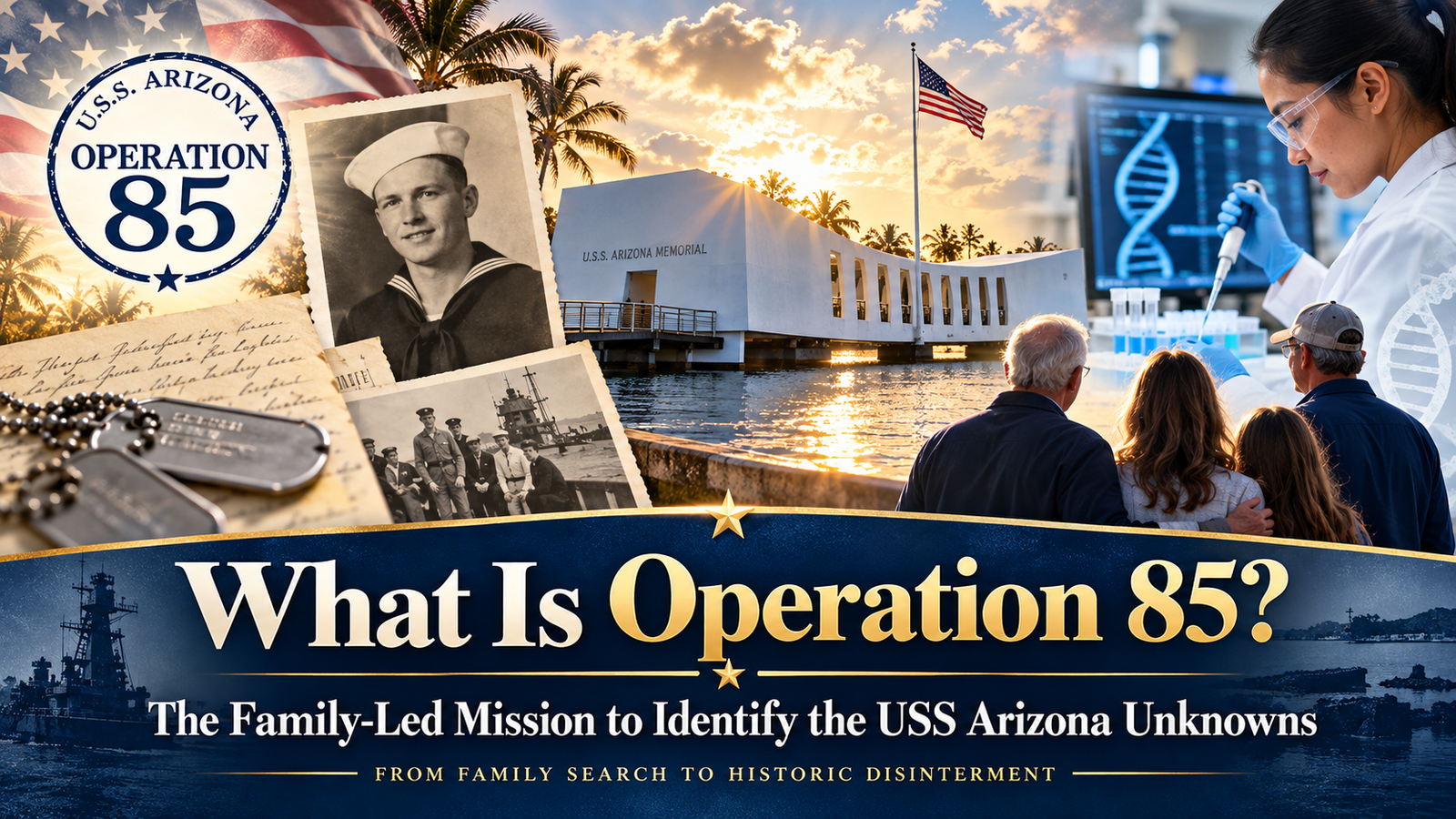
What Is Operation 85? The Family-Led Mission to Identify the USS Arizona Unknowns
September 24, 2026 | Washington D.C.
If you are a family member of a U.S.S. Arizona crew member and have only recently heard about Operation 85, you are not alone. New families continue to discover this mission every week, and many are learning for the first time that their family may have an important role in one of the most significant World War II identification efforts undertaken since the attack on Pearl Harbor.
Operation 85 began with a simple question: Could modern DNA, genealogy, and determined family outreach finally help identify the U.S.S. Arizona crew members who were recovered after December 7, 1941, but buried as Unknowns? What began as a family-led effort has grown into an official partnership with the Defense POW/MIA Accounting Agency, a nationwide network of families, genealogists, researchers, scientists, government agencies, and supporters — and a mission now preparing to enter its most historic phase.
Why Operation 85 Was Created
Operation 85 was founded by U.S.S. Arizona family member Kevin Kline.
Kevin is the grandnephew of Gunner’s Mate Second Class Robert Edwin Kline, who was killed aboard the U.S.S. Arizona during the attack on Pearl Harbor on December 7, 1941. Like hundreds of other Arizona families, Kevin grew up knowing that his relative had never come home.
A family trip to Hawaii in 2022 changed the direction of his life. During that visit, Kevin learned more about a group of remains recovered following the attack that had been buried as Unknowns at the National Memorial Cemetery of the Pacific — commonly known as the Punchbowl — in Honolulu. He also learned that some of those Unknowns could potentially include members of the U.S.S. Arizona crew. That discovery raised a question that would become the foundation of Operation 85:
If modern forensic science and DNA technology exist, why couldn’t families help create the conditions necessary to identify these men?
Kevin began researching the Department of War accounting process, Family Reference Samples, genealogical requirements, and the policies governing the identification of missing service members. On April 6, 2023, Operation 85 was formally launched. What Kevin initially believed might be a short-term effort quickly became something much larger.
The Challenge: Finding the Families
One of the largest obstacles was DNA. The Department of War requires sufficient Family Reference Samples — commonly called FRS — from eligible relatives before a large-scale identification project can move forward.
At the beginning of Operation 85, only a small number of U.S.S. Arizona crew members were represented in the government DNA database. The challenge was enormous.
More than 1,000 U.S.S. Arizona crew members remained missing, and many of their closest relatives had already died. More than eight decades had passed since Pearl Harbor. Family lines had scattered across the United States and around the world. Names had changed. Families had moved. Records were incomplete. Some sailors had never married or had children. Others had relatives who had no idea they were connected to someone aboard the U.S.S. Arizona.
Operation 85 had to find them.
Building a Nationwide Family Search
Operation 85 began developing a large-scale genealogy and family outreach effort. Kevin built a team and that team or highly experienced and qualified researchers built family trees, searched historical records, located living relatives, contacted families, explained the mission, and helped connect eligible relatives with the appropriate government offices responsible for issuing Family Reference Sample kits.
The work required genealogy, research, communications, technology, persistence, and an enormous amount of trust from families. Over time, Operation 85 assembled a team that included family members, professional genealogists, researchers, volunteers, technology specialists, and advisors. The organization also began working closely with the Defense POW/MIA Accounting Agency, the Armed Forces DNA Identification Laboratory, and the military Service Casualty Offices responsible for working with families of missing service members. The goal was never simply to collect names. The goal was to build enough scientifically useful family representation to give the U.S.S. Arizona Unknowns a realistic opportunity to be identified.
Reaching the 60 Percent DNA Threshold
The key milestone was a Department of War threshold requiring 60 percent of the missing U.S.S. Arizona crew to be represented by family DNA.
The confirmed number of missing U.S.S. Arizona crew members used for the project was 1,071. That meant 643 crew members needed family representation before the disinterment project could advance. When Operation 85 began, the number represented was only a fraction of that total, 25 to be exact.
For more than three years, the team worked case by case and family by family. Hundreds became involved. Then hundreds more. Eventually, Operation 85’s family search surpassed the required threshold. The project was not funded by the Us Government, instead nearly $150,000 of Kevin Kline’s personal money funded the physical costs of the project and all the rest was a labor of love from the volunteers. What had once appeared nearly impossible had become achievable. The milestone transformed the future of the U.S.S. Arizona identification project.
From “Will This Ever Happen?” to “What Happens Next?”
For years, U.S.S. Arizona families asked one question more than any other: Will these Unknowns ever be identified?
Today, the question has changed. Families are now asking: How will the identification process work?
That change represents one of the greatest achievements of the mission. The project has moved from uncertainty about whether an identification effort would ever happen to preparing families for an actual disinterment and identification process. The Department of War is now preparing for the disinterment of 141 Pearl Harbor Unknowns associated with the U.S.S. Arizona identification effort and related Pearl Harbor cases. Those remains will undergo an extensive scientific identification process that may include DNA analysis, dental and anthropological examination, historical research, and other forms of forensic evidence.
Operation 85 Becomes an Official DPAA Partner
Operation 85’s relationship with the Defense POW/MIA Accounting Agency developed over several years. The organizations worked together throughout the U.S.S. Arizona effort on family outreach, genealogy, DNA participation, communications, and preparations for the identification project. In 2026, that relationship was formally established through a Memorandum of Understanding.
Operation 85 is now an official partner of the Defense POW/MIA Accounting Agency. The agreement establishes a framework for continuing work with U.S.S. Arizona families while also exploring how Operation 85’s family outreach, genealogy, research, and technology capabilities may support the broader POW/MIA accounting mission. For Operation 85, that represents an important evolution. The mission began with one ship. The lessons learned from that mission may ultimately help many more families.
Recognition for the Mission
The success of Operation 85 has also received recognition from Department of Defense leadership. In May 2026, DPAA Director Kelly McKeague presented Kevin Kline with the DPAA Superior Public Servant Award in recognition of his work and Operation 85’s contribution to the U.S.S. Arizona accounting mission. For Kevin, the recognition represented something larger than an individual award. It reflected more than three years of work by researchers, genealogists, volunteers, government partners, and — most importantly — U.S.S. Arizona families who answered phone calls, opened letters, shared family histories, and agreed to provide DNA. Without those families, none of this would have been possible.
December 7, 2026: A Historic Moment for Families
The next chapter of the mission begins on December 7, 2026 — the 85th anniversary of the attack on Pearl Harbor.
Registered U.S.S. Arizona family members will gather in Hawaii for events associated with the beginning of the disinterment effort. Because these events are reserved for eligible and registered family members, event invitations, schedules, transportation information, and RSVP instructions are distributed privately through Operation 85 and appropriate government channels.
Public registration links for family events are not posted on the Operation 85 website. Family members who wish to receive family-specific information about the December events must first be registered with Operation 85 and/or with their appropriate military Service Casualty Office. For many families, December 7 will represent something generations before them never believed they would see. The beginning of disinterment does not mean every Unknown will immediately be identified. Forensic identification can take time, and every case presents different scientific challenges. But December 7 marks the beginning of a process families fought for, supported, and helped make possible.
For Operation 85, it also represents the transition from the first phase of the mission — finding the families — into the next phase: helping bring names back to the Unknowns.
If You Are a USS Arizona Family Member, You Have Not Arrived Too Late
If you recently discovered Operation 85 because someone contacted your family about a U.S.S. Arizona crew member, you have not arrived too late. Family participation remains important.
Additional Family Reference Samples can still strengthen the government’s ability to make identifications, even though the original threshold has already been reached. You also do not need to understand the entire process immediately.
Operation 85 works to help families understand:
- why their relative may be important to the identification mission;
- what a Family Reference Sample is;
- which family relationships may be useful for DNA comparison;
- how the official government DNA process works;
- what will happen during and after the disinterment effort;
- and how families can remain informed as the project continues.
Operation 85 does not collect or analyze DNA. Official Family Reference Samples are handled through the appropriate United States Government process, including the military Service Casualty Offices and the Armed Forces DNA Identification Laboratory. There is no cost to families for an official Family Reference Sample kit. Family Members can register online with Operation 85 HERE
How USS Arizona Family Members Can Register
U.S.S. Arizona family members who want to receive family-specific updates, invitations, and information related to the identification mission should make sure they are properly registered.
Families may register in either of two ways: Register with Operation 85 through the Family Member page on this website, or. Register directly with the appropriate military Service Casualty Office. Once a family member is registered and eligibility is confirmed, family-specific information can be provided through private communications. Operation 85 does not publish private family event links, invitation links, or RSVP information on public website pages. This protects the integrity of family-only events and ensures that information is provided to eligible and registered relatives.
Family Members can register online with Operation 85 HERE
Who Is Operation 85 Today?
Operation 85 remains fundamentally what it was when the mission started: a family organization. Its leadership includes relatives of missing service members, professional researchers, genealogists, and people committed to the POW/MIA accounting mission. The organization is independent of the United States Government, while serving as an official DPAA partner and coordinating with the agencies responsible for accounting for missing American service members. That distinction is important. Operation 85 exists to help bridge the space between families and the complex government accounting process. We help locate families. We help explain the mission. We help families understand what is happening. And we work with government partners to make family participation easier, more efficient, and more understandable.
The Mission Has Grown — But the Purpose Has Not Changed
When Operation 85 began in 2023, success was far from guaranteed. There was no certainty that enough families could be located. There was no certainty that the DNA threshold could be reached. There was no certainty that a U.S.S. Arizona disinterment project would ever happen. But families kept saying yes. Researchers kept searching. Genealogists kept building family trees. Scientists kept advancing the capabilities of DNA identification. Government partners kept working through the difficult questions. And slowly, a mission that once seemed impossible became possible.
Today, the U.S.S. Arizona Unknowns are moving closer to identification than at any point since they were buried more than eight decades ago.
If You Are a USS Arizona Family Member, Welcome
If you recently discovered Operation 85, we want you to know something very simple: Welcome.
You are part of this story too. Whether your family has followed this effort for three years or learned about it yesterday, the mission belongs to every family connected to the men of the U.S.S. Arizona. There will be much more to learn as the identification process begins. Operation 85 will continue providing families with updates, explaining the process, answering questions, and working with DPAA, AFDIL, and the Service Casualty Offices throughout the next phase of the mission. What began as an effort to determine whether the U.S.S. Arizona Unknowns could ever be identified has become something very different. Now, we are preparing to find out their names.
Family Members can register online with Operation 85 HERE
OPERATION 85, Unknown No More