
USS Arizona Families: How to Verify DNA and Genealogy Outreach
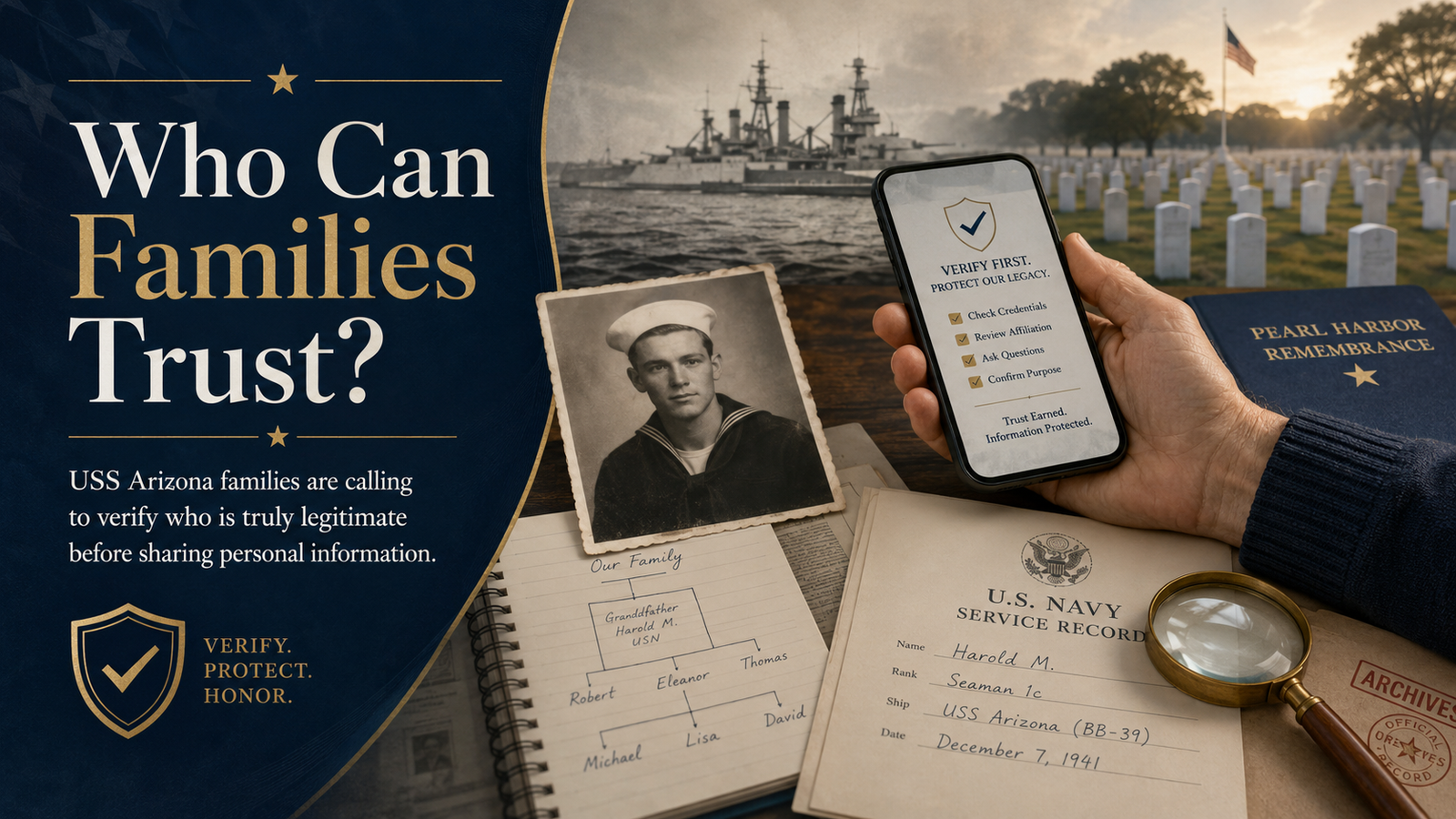
USS Arizona Families: How to Verify DNA and Genealogy Outreach
For families connected to the U.S.S. Arizona, participation in the effort to identify the Unknowns can involve deeply personal information, including family relationships, genealogy, contact information, historical records, and Family Reference Samples used for DNA comparison.
As the U.S.S. Arizona identification mission has expanded, family members may receive outreach from different individuals and organizations involved in genealogy, casualty assistance, family research, or the broader POW/MIA accounting mission.
Operation 85 encourages every family member to follow one simple rule:
Before sharing personal information, verify who is contacting you and understand their role.
Why U.S.S. Arizona families may be contacted
The identification of World War II Unknowns often depends on family participation. Eligible relatives may be asked to provide family history, confirm relationships, help locate other relatives, review genealogical information, or provide a Family Reference Sample for DNA comparison.
Because several organizations and government offices may play different roles in this process, families should feel comfortable asking questions before providing personal information. Verification is not an accusation. It is simply a responsible step when dealing with sensitive family information.
Different organizations may have different roles
A family member may be contacted by:
A representative of a military Service Casualty Office
A government contractor working on behalf of a federal agency or military service
A genealogist conducting authorized family research
The Defense POW/MIA Accounting Agency (DPAA)
The Armed Forces Medical Examiner System’s Armed Forces DNA Identification Laboratory (AFDIL)
Operation 85
A nonprofit organization or volunteer assisting with historical or genealogical research
An independent researcher or historian
These roles are not interchangeable. Someone conducting legitimate outreach should be able to clearly explain who they represent, why they are contacting you, and how the information you provide will be used.
Questions families should feel comfortable asking
If someone contacts you regarding a U.S.S. Arizona crew member, genealogy, DNA, or family history, it is reasonable to ask:
Who do you represent?
Are you a government employee, government contractor, nonprofit representative, genealogist, volunteer, or independent researcher?
What organization or office authorized or requested this outreach?
What information are you requesting, and why is it needed?
How will my personal information be stored and protected?
Will my information be provided to a government agency?
Who can I contact independently to verify your role?
A person conducting legitimate outreach should be willing to answer these questions clearly. Families should never feel rushed or pressured into providing personal information.
Family Reference Samples are part of an official government process
Family Reference Samples used in the official accounting process are handled through the appropriate United States Government channels. Operation 85 does not collect or analyze DNA.
When an eligible U.S.S. Arizona family member is identified, Operation 85 may assist with genealogy, family outreach, education, or connecting that individual with the appropriate government office.
The official DNA collection and identification process is conducted through the appropriate military Service Casualty Office, AFDIL, DPAA, and other authorized government components.
There is no charge to a family member for an official Family Reference Sample kit or participation in the government identification process. No donation or purchase from Operation 85 is ever required to participate in the U.S.S. Arizona identification mission.
Protecting Personal Information
Genealogical research can involve sensitive information, including:
Full names
Dates of birth
Home addresses
Telephone numbers
Email addresses
Family relationships
Adoption or marital history
Family trees
Historical records
Information about living relatives
Families should use the same care with genealogical information that they would use with any other sensitive personal information. Before sending records or identifying information, understand who is receiving it and why.
Operation 85’s role
Operation 85 was founded by U.S.S. Arizona family members to help locate relatives of the missing crew and increase family participation in the identification mission.
Since 2023, Operation 85 has worked with U.S.S. Arizona families and coordinated with the government agencies responsible for the POW/MIA accounting mission.
Operation 85 is an independent nonprofit organization and does not replace the official role of the Department of Defense, DPAA, AFDIL, or the military Service Casualty Offices. However, Operation 85 is an official partner of the Defense POW/MIA Accounting Agency (DPAA).
Our role is to help families understand the mission, locate eligible relatives, support responsible genealogy and outreach, and connect families with the appropriate official government process.
If you are unsure about an outreach contact
If you receive an unexpected call, email, letter, or message concerning a U.S.S. Arizona crew member and are uncertain about the person contacting you, you have several options.
You can ask the individual to provide the name of the organization or government office they represent and independently verify that information. You may also contact the appropriate military Service Casualty Office directly.
U.S.S. Arizona family members may also contact Operation 85. We can help explain the different organizations involved in the mission and, when appropriate, help direct you to the government office responsible for the outreach. Our goal is not to interfere with legitimate research or official government activity. Our goal is to make sure families understand who they are communicating with and feel informed and comfortable throughout the process.
A simple rule: verify before you share
Before providing personal information, understand who is requesting it. Before sending family records, understand where they are going. Before providing information about another relative, make sure you understand how that information will be used. And if you are uncertain, ask questions.
The U.S.S. Arizona accounting mission depends on trust between families, researchers, government agencies, and the organizations supporting this historic effort. Protecting that trust benefits everyone. The men of the U.S.S. Arizona deserve an identification effort built on cooperation, transparency, professionalism, and respect for their families. Operation 85 will continue working toward exactly that goal.
This Mission Belongs to the Families
The U.S.S. Arizona Unknowns are not case numbers. They are sons, brothers, uncles, cousins, shipmates, and loved ones. Their families deserve honesty, clarity, and respect at every step. Operation 85 will continue working to protect that trust. Because identifying the Unknowns is not just about science. It is about families. It is about dignity. And it is about making sure the men buried without names are never again surrounded by silence, confusion, or uncertainty.