
What Families Should Know About World War II Unknowns and the Identification Process
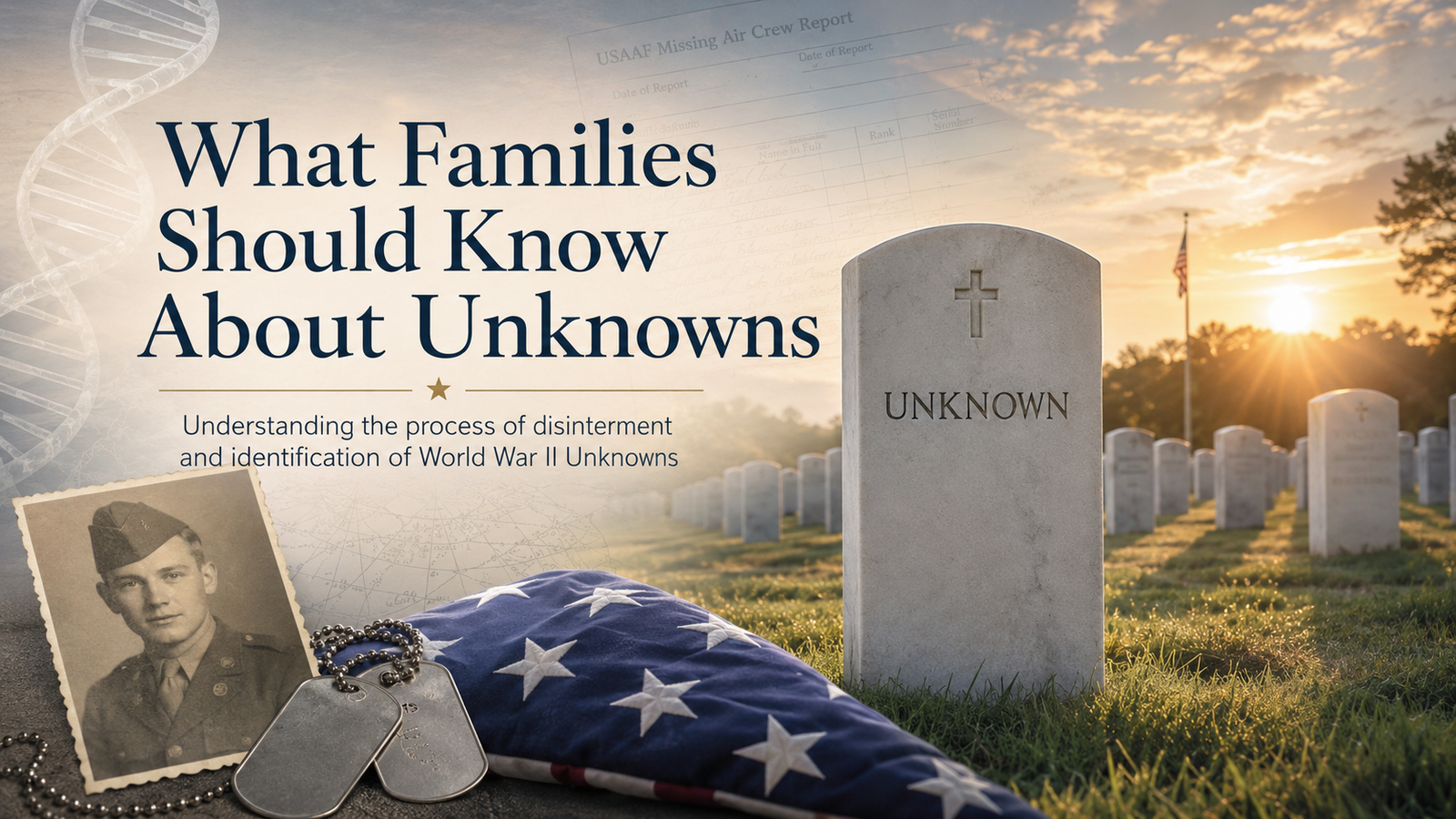
What Families Should Know About World War II Unknowns and the Identification Process
What Families Should Know and Understand About Unknowns
For many World War II families, the word “Unknown” can feel cold, confusing, and final. It is carved into a headstone, listed in military records, or spoken in government briefings as if it explains everything.
But “Unknown” does not mean forgotten. It does not mean impossible. And today, because of historical research, forensic science, DNA testing, and family participation, many of those once considered unidentified may finally have a path back to their names.
That is the heart of Operation 85’s mission: not to search broadly for every service member missing from World War II, but to focus on those who were recovered, buried, and left behind as Unknowns.
What is an “Unknown”?
An Unknown is not simply someone who is missing.
In the context of World War II identification work, an Unknown generally refers to recovered remains that could not be identified after the war and were buried under a marker reading “Unknown.” DPAA’s Family Member Guide explains that these remains may be a single individual, or they may include multiple individuals buried together in a group because the circumstances of death, recovery, and burial were too complex to resolve at the time.
That distinction matters.
Operation 85’s mission is focused on those men who were already recovered after the attack on Pearl Harbor, could not be identified with the tools available at the time, and were buried as Unknowns. In other words, this is not about speculation. It is about reopening cases where the remains exist, the historical record points to possible identities, and modern science may now be able to do what the 1940s and 1950s could not.
Why were World War II Unknowns not identified at the time?
After World War II, graves registration personnel made significant efforts to recover and identify the dead. They used investigators, morticians, dentists, anthropologists, and the best scientific methods then available. But many cases remained unresolved because the remains were too fragmentary, records were incomplete, or multiple men died and were buried together under circumstances that could not be untangled with the technology of that era.
That is especially important for mass-casualty events like Pearl Harbor. When a ship exploded, burned, sank, or suffered catastrophic damage, the recovery and identification challenges were enormous. In some cases, remains were recovered from the ship or surrounding areas, processed after the attack, and buried in cemeteries as Unknowns because no reliable individual identification could be made.
Today, that does not have to be the end of the story.
What changed?
Three major things changed: better historical research, better forensic science, and better DNA technology.
DPAA’s guide explains that modern forensic tools — including DNA, dental analysis, skeletal analysis, and improved historical comparison — now allow unidentified remains to be reassessed. When research supports the possibility of identification, DPAA can propose that Unknown remains be disinterred and brought into the laboratory for new analysis.
For World War II Unknowns, DPAA has stated that advanced historical research and forensic analysis, including DNA, are central to the effort. These cases range from large mass-casualty events like Pearl Harbor to smaller aircraft or vehicle losses where the occupants could not be identified with older technology.
That is the opening Operation 85 saw: the science had changed, but the family-reference-sample network had to be built.
What does “disinterment” mean?
Disinterment means the respectful removal of remains from a grave so they can be transferred for forensic examination and possible identification.
This is not casual. It is not automatic. It is not done just because a family asks. DPAA does not independently authorize disinterments. According to DPAA’s guide, once historical and forensic analysis is complete, DPAA requests approval. That request is reviewed by multiple offices, including the relevant Service Casualty Office, AFMES-AFDIL, and the cemetery authority. If those offices concur, the packet goes forward for final decision. If approved, DPAA coordinates with the cemetery to schedule and conduct the disinterment.
In plain English: before an Unknown is disinterred, the government must be able to show that there is a reasonable path toward identification. That path is built from records, science, and family DNA.
Why does DNA matter so much?
DNA is not the only evidence used in an identification, but it is often the key that unlocks the case.
AFMES-AFDIL, the Armed Forces DNA Identification Laboratory, processes DNA reference samples for DPAA. Depending on the family relationship, scientists may use mitochondrial DNA, Y-chromosome DNA, or nuclear/autosomal DNA.
Family Reference Samples, often called FRS, allow scientists to compare DNA from recovered remains against living relatives of the missing service member. Parents, children, siblings, grandparents, grandchildren, maternal-line relatives, paternal-line male relatives, and other properly documented family members may all be useful depending on the DNA type needed.
And this is where families become more than observers. They become part of the evidence.
What are the disinterment thresholds?
For Unknowns, the government generally requires a certain level of identification potential before approving disinterment.
DPAA’s Family Member Guide explains that for commingled group remains, DPAA must have DNA or other medical means of identification for at least 60% of the service members associated with the case. For individual Unknown remains, the threshold is at least 50% of the associated personnel.
DPAA’s own disinterment briefing further explains that these thresholds often apply most directly to the number of Family Reference Samples available. For a group of Unknowns, DPAA generally must show it has the ability to identify 60% or more of the group; for a single Unknown, the figure is at least 50% of the possibly associated candidates.
That is the part many families do not realize: even if the remains exist, even if the history is strong, and even if the science has improved, the case may still wait until enough family DNA is on file.
No DNA, no comparison. No comparison, no confidence. No confidence, no disinterment.
It is a brutal little math problem sitting on top of an 80-year-old wound.
What Operation 85 did differently
For years, families of USS Arizona crew members were told, in different ways, that identifying the Arizona Unknowns was too difficult, too expensive, too complex, or too unlikely.
Operation 85 challenged that assumption by doing the unglamorous work that makes disinterment possible: locating families, documenting relationships, explaining the process, encouraging participation, and helping build the Family Reference Sample base needed to meet the threshold.
DPAA publicly acknowledged that the 60% DNA Family Reference Sample threshold had been met for the USS Arizona Unknown Identification Project and stated that reaching that threshold allows DPAA to formally request and begin planning the disinterment of potentially 141 Unknowns buried in multiple potentially commingled graves at the National Memorial Cemetery of the Pacific in Honolulu.
DPAA also publicly thanked Kevin Kline and the Operation 85 team for their devoted efforts over the past three years to locate and connect enough USS Arizona families to help reach that milestone.
That is not a small footnote. That is the proof of concept.
The system required family participation. Operation 85 built the family network.
What families should expect from the process
Families should understand that identification is not instant after disinterment. Once remains are removed, they must be transferred, documented, examined, sampled, and compared. DPAA’s guide notes that laboratory analysis can take months to years depending on the case, condition of remains, available records, and available DNA references.
Families should also understand that DNA alone may not be enough. A final identification can include several lines of evidence: DNA, dental records, skeletal analysis, historical records, burial records, material evidence, and the circumstances of the loss. DPAA’s West Loch disinterment article described DNA as the “driving force,” but also noted that historical, anthropological, and dental analyses are part of the identification process.
That is why every family member who participates matters. One DNA sample may help confirm a match. Another may help exclude the wrong match. Another may strengthen a family line. Another may help move a group case above the threshold needed to proceed.
What families can do now
The most important step is to make sure eligible family members are known and connected to the case. DPAA’s guide states that the best way families can help is by providing a Family Reference Sample. Photographs of the service member may also assist the process, especially clear images showing the face, smile, or forehead.
For USS Arizona families and other World War II Unknown cases, this means:
Confirm your relationship to the service member.
Complete the required family information.
Submit a Family Reference Sample if you are eligible.
Encourage other relatives on the maternal or paternal line to participate.
Share photographs, records, letters, or family documentation that may support the case.
DPAA’s DNA privacy guidance also states that family DNA is not tested for diseases or genetic disorders, is not sent to the criminal National DNA Index System, and is assigned to a secure case file.
Why this matters
An Unknown is not a nobody.
An Unknown may be someone’s uncle, brother, grandfather, cousin, shipmate, or son. In many families, he has been spoken of for generations without a grave they could fully trust, without a final answer, and without the dignity of his own name restored.
World War II Unknowns were not left unidentified because no one cared. They were left unidentified because the science, records, and circumstances made it impossible at the time.
But “impossible at the time” is not the same as impossible forever.
That is why Operation 85 exists. To help families understand the process. To gather what the system needs. To push these cases from forgotten paperwork into active pursuit. And to make sure that the men buried as Unknowns are given every modern chance to be known again.
For the families of the USS Arizona and other World War II Unknowns, this mission is not about reopening the past for the sake of history.
It is about finally closing the distance between a name, a family, and a grave marked Unknown.
Sources:
DPAA Family Member Guide
Defense POW/MIA Accounting Agency; A search for Answers